
Ground-borne noise
Ground-borne noise (GBN) is one of the most challenging environmental impacts to measure and manage. Traditionally it needed intrusive indoor microphones, specialist analysis and complex reporting.
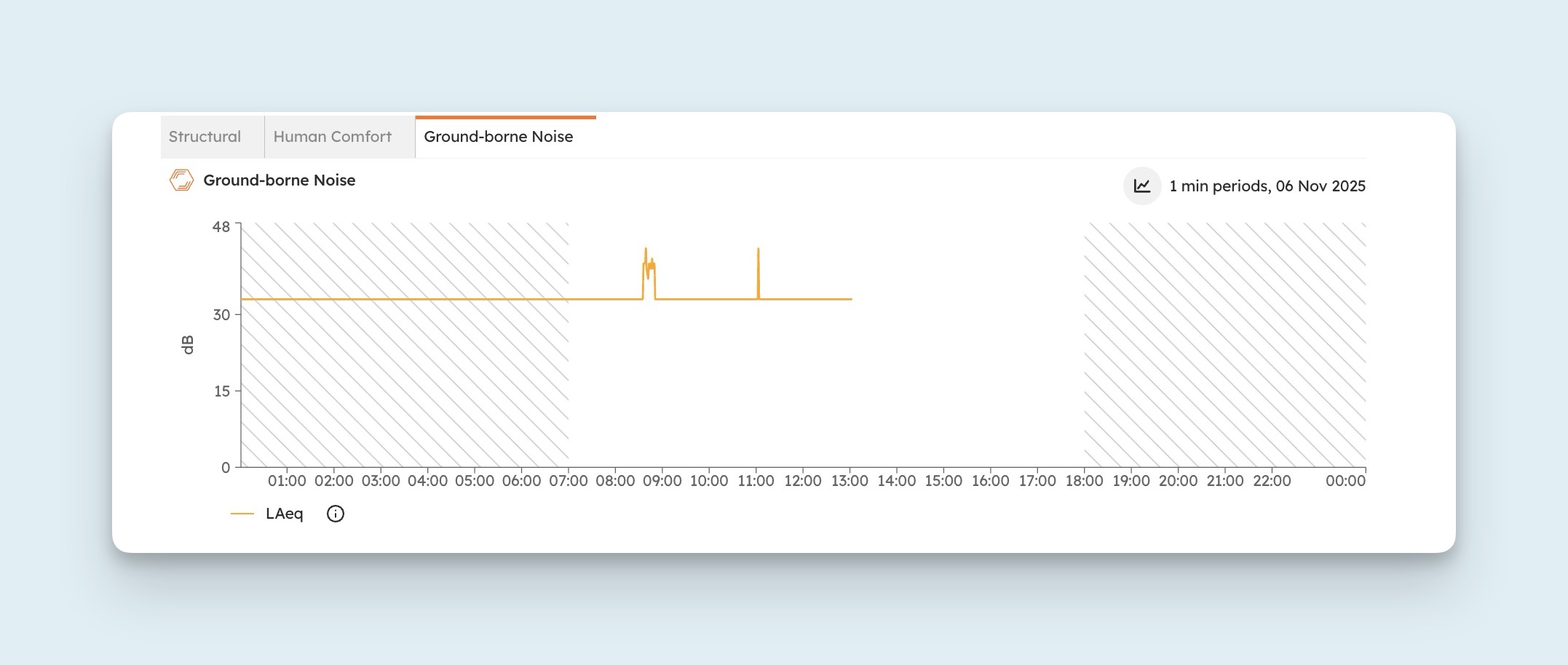
With SiteHive you can measure and manage ground-borne noise in real time using your SiteHive Hexanode Vibration devices, with no need to enter properties or install additional sensors.
What is ground-borne noise?
Ground-borne noise is low-frequency sound generated by vibration travelling through the ground and structures.
It is typically heard as a low rumbling or humming noise, even though it originates from vibration rather than airborne sound.
This vibration travels through the ground into building structures and can:
Be felt as vibration, and
Be heard when it re-radiates as sound through walls, floors or ceilings.
Ground-borne noise is commonly associated with:
Tunnelling and rail projects
Underground construction
Piling and rock hammering
Heavy vehicle movements or TBM operations
Because it travels through the ground, GBN is often more noticeable at night and can feel louder than airborne noise, which makes it a key factor in community amenity and complaint management.
What we offer
Real-time, remote and scalable
The SiteHive Hexanode Vibration device measures vibration at high frequency and converts it into real-time estimated ground-borne noise in LAeq (dB), giving you actionable data on the SiteHive Dashboard as it happens.
Unintrusive and practical
No more indoor microphones or complex set-ups. Deploy your Hexanode Vibration devices at sensitive receiver locations and you are ready to monitor.
Validated
Developed in collaboration with industry experts and validated on major projects, including Sydney Metro West (ETP).
Designed for real-world compliance
Built around the NSW Interim Construction Noise Guideline (2009) and aligned with international best practice.
ℹ️ Ground-borne noise is switched on per site. To have it enabled, contact your Regional Success Manager or support@sitehive.com.
How it works
SiteHive's GBN estimation converts vibration into noise using a validated, transparent methodology, performed automatically by the Hexanode Vibration device and the SiteHive Enviro software.
Hexanode Vibration device
Records raw vibration data at high frequency.
Applies A-weighting to account for human hearing sensitivity.
Calculates Vsum (A-weighted combined vibration velocity).
Sends the maximum A-weighted Vsum per integration period (typically 1 minute) to the cloud.
SiteHive Enviro software
Applies a scaling factor (user configurable, typically between 27 and 35) to that A-weighted vibration level to estimate the equivalent noise level (LAeq).
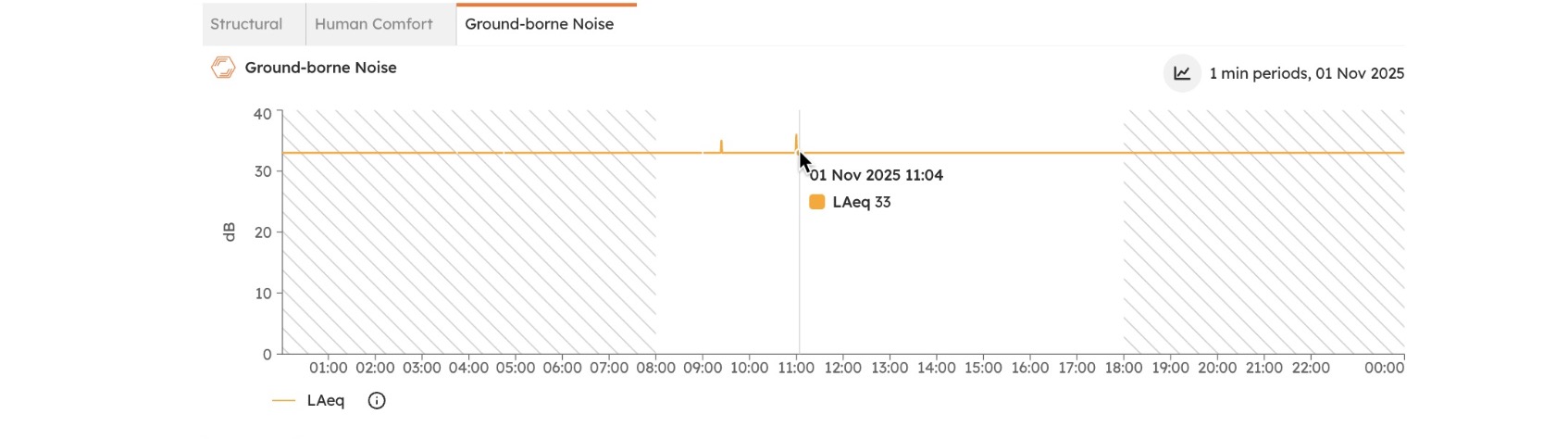
Displays ground-borne noise (GBN) directly on your Dashboard.
Graphs GBN levels alongside PPV and VDV, giving you a complete picture of vibration and its acoustic impact.
💡 The GBN scaling factor accounts for factors such as distance from the source and building resonance, giving location-specific estimates. Ask your acoustic consultant which factor applies to your site, and we will configure it for you.
Data display and reporting
Shown directly in decibels (LAeq), so results are clear even for non-specialists.
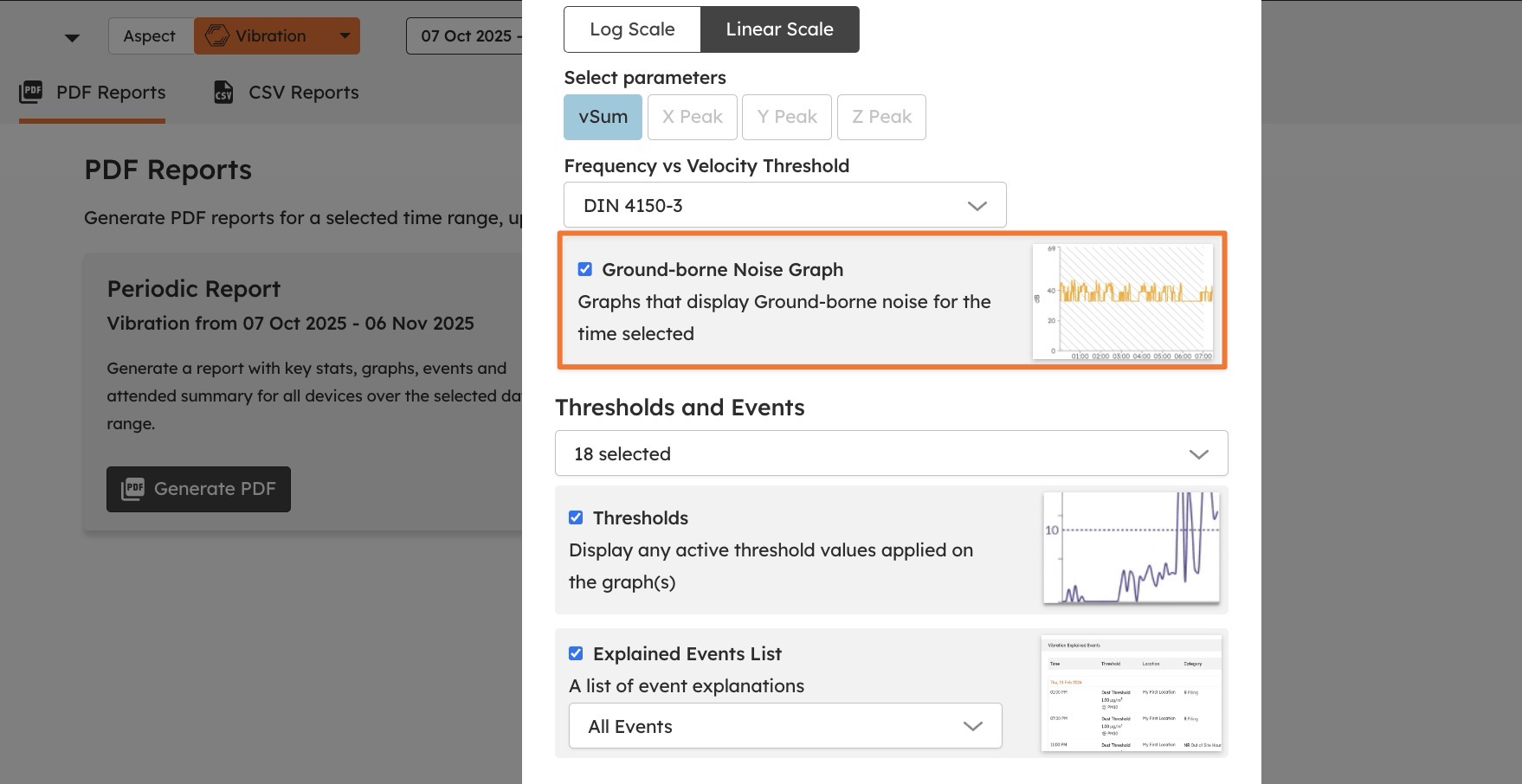
Integrated into reports: GBN values appear alongside PPV and VDV in your configurable PDF reports.
Available in graphs and dashboards: see trends over time and assess against your management criteria with rules and notifications.
Why it matters
Ground-borne noise has significant impacts on community comfort and project compliance.
With SiteHive you can:
Monitor GBN continuously, 24/7, without intrusive set-ups.
Act quickly when levels approach guideline limits.
Demonstrate compliance transparently with validated, reliable data.
Build community trust by reducing intrusive investigations and improving responsiveness.
What's next
SiteHive Vibration: what it measures and how (the device behind the estimate: PPV, VDV and waveforms)
Waveform classification: what caused the vibration (AI labels every exceedance construction or non-construction)
Vibration Criterion (VC) curves (monitoring for sensitive equipment)